All the Houses in a Quiet Neighborhood (Part 1)
By Kikuko Tsumura
Translated by Ryan Koski
Fall 2025 Translation Practicum at the Middlebury Institute of International Studies (MIIS)
Translator's note: Before we hop into the story, I wanted to mention why I chose to translate this piece. When I first arrived in Joso, Ibaraki to teach for the JET program, I quickly realized that there wasn't much out in the countryside where I would be living apart from a gym, two grocery stores, a ramen restaurant, a hotel, and a train station. So, I was ecstatic to see that there was a bookstore attached to one of the grocery stores. When I first went to visit it, this is the book that I bought, marking my first book that I bought as an official semi-permanent resident of Japan.
As work became busy and I studied Japanese is most of my down time to pass proficiency tests, this story just sat patiently on my shelf.
Fast-forward three years, and I'm in California, studying translation at Middlebury (MIIS). As a second year student, I need to choose a piece to translate as a practicum. I jumped on the opportunity to finally read this story, and to be able to translate it for you all to enjoy, too.
Disclaimer: I don't own the rights to the original story. While I plan to reach out to the author and publisher to see if they would like me to continue translating it publication, I make no money off of the translation published here. The translation is my own, but is unofficial. The purpose for this translation is for me to practice translating techniques and processes, to provide potential partners/employers a sample of my work that demonstrates my creative and technical abilities, and to share my work with my friends and family that are curious about my translations.
Special thanks to my mom, Lorrie Henrie-Koski for proofreading my translation!
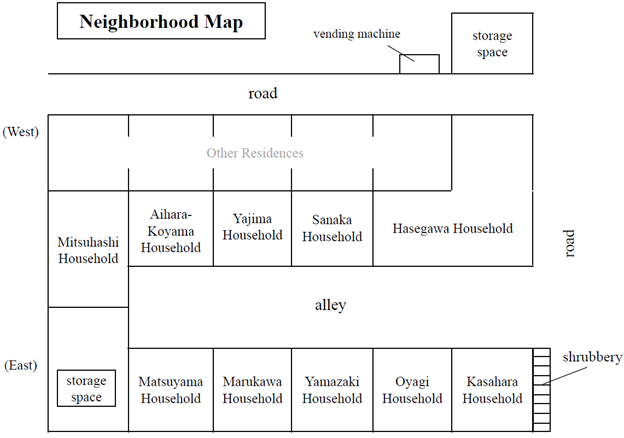
・Kasahara Household - two residents: Etsuko, 75-year-old wife; Takenori, 80 year-old husband
・Oyagi Household - one resident: Nozomu, 25-year-old man
・Yamazaki Household - one resident: Masami, 58-year-old Woman
・Marukawa Household - two residents: Akari, father; Ryota, 3-grade son
・Matsuyama Household - one resident: Moto, a young man in the prime of his life
・Mitsuhashi Household - three residents: Akiyoshi, father; Hiroko, mother; Hiroki, 12-year-old son
・Aihara-Koyama Household - two residents: Takahiro, husband; Atsuko, wife - A couple in their 40s
・Yajima Household - four residents: Grandmother; Mother; Mizuki and Yukari, sisters, both in elementary school
・Sanaka Household - two residents: Elderly mother; Koichi, 36-year-old son
・Hasegawa Household - six residents: Saya, grandmother; Shizumi, Mother; Hiro, Father; Maya, Chisato, Shourin, children
1. The People
Waking up on time, Ryota sluggishly starts changing into his middle school uniform. He irons his slacks and his button-up shirt. This uniform is a little too stiff. It makes him feel like he is being forced to stand up. Previously, he would have gone back to bed until it was time to eat, but wearing clothes made of material this rigid does not put him in the mood to lie back down.
After shaking his arms out a little to alleviate the strange feeling of the material on his upper body, Ryota grabs the strap of his backpack lying on the floor and leaves his room. He goes directly into the room next to his. His mother’s room. As always, the room is pitch black. He gets up onto the bed on his knees and opens the window and the screen, then pushes the heavy metal shutters to the side. He recoils and turns his face away from the sudden harsh sunlight. He shakes his head a little at the thought of how outrageous it is that he’s the one that has to do all of this.
Having completed his task of giving his mother’s room a little light and fresh air, he closes the window. He goes through the living room where his family’s miscellaneous things are stored, goes out onto the veranda, and takes down the laundry. When he had told his dad that he hated doing laundry in the morning, his father had responded saying, “But if we just leave the laundry hanging up; people will start wondering why your mother hasn’t taken it down.”
When Ryota objected, “Well, if people can see me doing the laundry, people will definitely wonder about mom, won’t they?”, his father had said that it was fine, since the veranda was not facing the street.
“But what if the neighbors see me? Like O-chan or Kao-bachan, their verandas are facing the same direction.”
“You’re fine. Mr. Matsuyama does all his laundry at the laundromat, and Ms. Yamazaki does her laundry in the evening after she gets home from her part-time job.”
Ryota had wanted to say that it was rude to have observed their single neighbors to either side of them to that degree, but just talking to his father any more than that would stress Ryota out, so he held his tongue.
So for now, he does the laundry, leaving the clothes on their hangers piled up in the room. Folding them is his father’s job. With a strap of his backpack slung over a single shoulder, Ryota finally goes downstairs to the first floor where he is met with the delicious smell of frying bacon. The voice of his father saying good morning to him comes from the kitchen. After washing his face and brushing his teeth, Ryota sits at the kitchen table. Breakfast is an English muffin topped with bacon and scrambled eggs, a cold potato soup, and some vegetable juice. Holding the English muffin in both hands, he takes a big bite. The scrambled eggs are just right, neither too dry nor too soft. It makes him a bit mad that his father proved himself a relatively good cook after his mother left them.
“Ryota, look.”
His father motions to the television, but Ryota just sits without lifting his head, eating his breakfast. His father repeats himself. “Ryota, look at the TV.” Having been told twice, he reluctantly decides to look up. The people on TV are talking about a story he has heard a few times in the last couple days. A missing fugitive. It looks like she escaped from a prison a few prefectures over.
“It’s sort of rare to hear about a woman escaping from prison, don’t you think?”
“I dunno.”
“Yeah, come to think of it, I’ve never heard of it before,” his father continues, not shrinking from his son’s cold treatment. “Be careful. It looks like she’s headed our way.” He points to the map on TV showing the locations of security cameras in parking lots and businesses that were thought to have caught the fugitive on film, showing her path gradually approaching the area they lived in. This was stuff that Ryota had already read about in the news online and talked about in school.
“I mean really, what’s her goal in doing this sort of thing? I heard on another program that she didn’t even have that long of a sentence….” Ryota listens to his father’s reproachful commentary, spooning the cold potato soup to his mouth. It really is tasty. His father has strong preferences, so when he decided to make it, he had probably read up on it extensively before actually cooking it. That was something Ryota’s mother had probably hated about him.
“It looks like the woman is from around this area.”
Ryota does not want to talk to his father very much, so he is lost for a moment about whether to respond, but he cannot suppress his urge of wanting to show his father that he knows things, too, so he says what he had heard about at school. More than just being “from around this area,” Ryota knows the neighborhood she is from.
“Really?”
“Really.”
His father’s eyes become wide and his jaw drops, just as surprised as Ryota expected he would be. Ryota feels just a little satisfaction at this.
“Wow, I’ve been so busy with work that I haven’t been keeping up with the things going on in this neighborhood, even though it’s been my turn to be the president of the residents’ association for our block since last month. I’ve got to be sure to properly gather my intelligence.” His father folds his arms. He even lets out a deep groan. Ryota has little time for being so theatrical, but he knows that his father is just someone who acts this way without meaning anything by it. Just saying that he knows something does not serve as any sort of consolation.
Keichi Nojima, a boy in Ryota’s class who goes to the same cram school and always walks home afterwards with him, knows a lot about this fugitive. He is a boy that normally does not have much interest in people’s gossip or in the news, but for some reason, he sometimes talks about her. The elementary schools that Nojima and Ryota went to were in different school districts, but when they were hanging out with a group of Nojima’s friends from elementary school once, one of his friends had been proudly telling the group a story that he had heard from his parents about how the fugitive’s family used to run a painting business but that it had gone bankrupt. Nojima turned to Ryota and corrected the story under his breath, saying it was a contracting firm.
The woman had been a good student, but after the family business went under, her academics went off the rails. Before long, she had turned to a life of crime. After compiling all the stories he had heard from people at school, this is the image Ryota had. He is also one of the better students in his class--he is not bragging by thinking so, this is just the objective truth--and since his mom left, he has become a child of a family that cannot really say it is happy. There is something about these similarities that weighs on him. You could say that he can sympathize with her a little. And so, apart from what he heard at school, he had also scoured the news for information. While he wonders why she would be so stupid as to do something like break out of jail, he secretly hopes she will get away. He even imagines encountering her and helping her. To a middle schooler like him, he did not even have a real understanding of what the crime of “embezzlement” was.
“You sure do know a lot about this, huh?”
“Not really.”
There is a faint glimmer in his father’s eyes, and Ryota thinks about how annoying his father’s way of talking is when he gets tense. As always, his father would likely research the matter, find something to do about it, grope around for a good way of doing it, then foist his plan onto the people around him. Like how he had said to Ryota, “Since I’ll call your mom Mondays, Wednesdays, and Fridays, you call her Tuesdays, Thursdays, and Saturdays. Then we’ll give her time on Sunday to think about things.”
Ryota and his mother usually communicate by texting each other, but it seems like she has been ignoring all the texts and emails from his dad. Ryota thinks to himself, Isn’t all this happening because of how you always approach making up from fights so robotically? Like it’s work?
“Now that I’m the president of the residents’ association, I better do things right. Dang it, today was going to be my day off, too.”
His father systematically uses his paid-leave day once a month. He usually takes it on the last Friday of the month, depending on how busy work is. He does jigsaw puzzles, goes to the batting cages, reads books. He says that he has fun, but it always seems like he is not quite satisfied. Ryota wonders if his father is not grasping that it’s actually convenient for this problem to happen during his monthly 3-day-weekend.
“I’ll have to set up a neighborhood watch with the people living in this area to make sure that the fugitive isn’t coming here.”
Ryota thinks that calling them “the people living in this area” is incredibly impersonal. It is probably because that is all his father thinks of them. From the outside, he is a stiff, formal man, so of course he would never make fun of the neighbors, but Ryota always had the sense that his father saw them as people whose lives had no connection to his own. That is why he does not want people to know that Ryota’s mother left them, either.
“The second floor of the Kasahara’s house might have the best vantage point since it’s at the entrance of the alley. It has windows facing the alley and the road, so we could have two points of entry that we can stand guard over.”
His father talks like he has intimate knowledge of the second floor of the Kasahara’s house, but Ryota knows that he does not interact with them apart from how they greet each other in passing. The ally where Ryota’s family lives comes to a dead end at the Mitsuhashi’s house with four families living on the western side and five families on the eastern side. The number of families on each side is different because the Hasegawas – living in the corner house at the entrance of the alley on the western side – own the houses next to and behind them. The houses have been connected and their family lives in all three. Mr. and Mrs. Kasahara’s house is across the street, on the eastern side of the alley entrance. Ryota’s family lives on the eastern side in the second to last house of the five as going down their alley.
“Except, if I were to do a lookout from the windows of the Kasahara’s house, the Hasegawa’s flower bed might become a blind spot…”
Listening to his father talk gradually becomes painful, so Ryota shovels the rest of his breakfast into his mouth, downs his vegetable juice, and picks up his backpack off the floor.
“What do you think, Ryota? See you after school!”
Confused as to which to respond to, Ryota just says, “Don’t bother the neighbors,” and leaves the house. Today is garbage day and his father already took out the trash.
***
“Hey, that’s the woman from my neighborhood!” Murasawa told Masami this countless times at the supermarket where they work together part-time. Masami asked Murasawa what her “neighborhood” was during their overlapping breaks yesterday, and Murasawa gave her the specific name of the area, but Masami had never properly looked at a map of their area and she did not know anyone else from there, so no matter how close their neighborhoods are, it did not ring any bells. Maybe it is also because it has only been two years and a few months since she moved back here. Seeing that Masami seemed puzzled, Murasawa explained that maybe it could not be called close to where Masami lives, but it was about two neighborhoods over, and that the elementary and middle schools there are in the same school district as the ones in hers.
Before she had come to work, Masami ran into a police officer that morning who mentioned the woman, too. She had woken up, washed her face, and immediately went to take the garbage out. When she did, she saw Mizuki, the older sister of the Yajima family, taking out a garbage bag that looked heavy, carrying it with both hands. The girl went back inside, and came back out, carrying another heavy bag. Masami offered to help her carry it, and just as she did, a young man in a policeman’s uniform came into the alley on a bike and called out to Masami. After greeting her good morning, he asked if she knew of a convict that was on the run.
Before she could say anything, Mizuki answered, “Oh, I know about her!” The policeman told Masami and Mizuki that, although it had not been confirmed yet, the police had received information that the convict might be on her way to the area, and to call 110 immediately if they heard any further information. He also told them to lock their doors and to be careful when they leave the neighborhood. And with that, he rode off.
“That’s scary, huh?” Masami said to Mizuki. The girl looked up at her and asked what the woman did to have to go to jail. Even though she was not sure the fourth grader would know what it was, she told her that it had been for embezzlement.
“Embezzlement?”
“It’s not like when a robber breaks into someone’s house, but it’s when someone steals money from a company that they work for.”
“How do you write it?”
“It’s the character for ‘width’, and the first character from the word for ‘territory’.”
“Oh, I know that one. Like, the one from ‘English territory in India,’ right?”
Wow, she really knows a lot, Masami thinks, and as if Mizuki can sense this, she answers saying that the phrase had been in a book that she had read when she was a first grader, “A Little Princess,” but she read it probably two or three years earlier, so it had been a long time since she had heard the word. Then, even though Masami should have been the one to say it, Mizuki said, “Please be careful, alright?” Masami cocked her head to the side a little in confusion from the whole situation and headed back inside.
A photo had also been posted in an article online of the woman. Thirty-six years old. She looks like a normal woman to a 58-year-old like me, Masami thinks. Wearing a white shirt with a collar, she looks very put together. She does not have any particularly discerning characteristics, with a thoroughly expressionless face. Her hair comes down to about her chin, her side-swept bangs trimmed to a length where they are not in the way. And somehow, she still leaves some sort of an impression. Masami thought that it wouldn’t have been strange if she had been her junior at work. And then, Masami remembers immediately how she had quit the company.
It stuck with Masami that the fugitive had opened an account especially for saving the money she embezzled, putting all the money she swiped from start to finish there. It seems like she had been living a frugal life, not spending even a single yen of the money she had taken. As Masami walks down the hallway going towards the kitchen, she says to her mother, “It’s rare to hear about a woman escaping from jail. Now and then you hear about a man doing it, but…”. But her mother is already gone. She knows this, but whenever she feels strongly about something, she tends to say it out loud anyway. For a short time, she had tried to not talk to herself, but when she works an extra hour at her part time job, she becomes more tired than she thinks she will, and she cannot help herself. This is probably how people go crazy. But Masami thinks that she is in a position where she does not have anyone she particularly needs to hold back for. The freedom of the thought feels nice, if not slightly lonely.
For breakfast, she eats a hardboiled egg and some toast. She gets a little tired of eating, and stares at a real-estate flier in the newspaper. It feels like this house is too big to be living in alone, so every day she checks the properties listed in the paper. On the other hand, her mother had lived in this house alone for a long time and filled it up with a lot of stuff, so Masami also thinks that maybe it would not be wise to move into a tiny new place.
She has not really gotten around to organizing all the things that her mother left in the house. She does not have the willpower. While she was alive, her mother did not seem like she had been accumulating garbage, but apparently, she had not gotten rid of anything at all from the house, from things that could still be used, to things teetering on the border of usable and unusable, to things that she had not used for decades. For the time being, Masami is not facing any financial hardship. It would probably be alright if she dialed back how many hours she works to the number of hours she used to at her part-time job, but leaving the house and working at the supermarket made her feel better than endlessly continuing to sort through her mother’s things at home--deciding what to keep and what to throw out--even if it was a little physically tiring.
Passing the stacks of cardboard boxes filled with large quantities of food products in the hall, Masami decides to leave for work. Right next to the cardboard boxes, there are large bottles of cooking sake, mirin, and soy sauce, all of which expired five years ago. Next to that is a Japanese doll. And next to that is a box for a sewing machine with utensils for performing tea ceremonies placed on top. Then, there’s a shoe box, and four more cases filled with food products. Masami lets out a sigh.
If she continues to leave these things where they are without sorting through any of them, people are going to start calling it a hoarder’s den. The Japanese doll of a Kappa sandwiched between the sewing machine box and the bottle of mirin is puffing out his cheeks and looks like he is saying, “They probably will, won’t they?”
“Creepy.” Masami gives him a nod of agreement and heads out for work to escape her obligations at home. The supermarket where she works is ten minutes away on foot. She even comes home to eat lunch sometimes, but today, she thinks she will just eat there.
***
Hiroko says to her husband, Akiyoshi, that maybe, after work, if they put the last box out in the yard for a while, they might be able to completely clear out the storage space. Akiyoshi gives her an affirmative nod as he eats the rest of yesterday’s seasoned rice. In it are their son Hiroko’s favorite ingredients – some konjac, carrots, and deep-fried tofu. Hiroki is still sleeping. Hiroko always wakes him up at 9:30 before she goes to her part-time job.
"I know we've been talking about it for a long time, but..."
"Right. The camera."
Hiroko and Akiyoshi begin to talk about something that the two of them have been arguing about for the past month and a half. Every time they see each other, it seems like their conversation has a three-part structure: talking about Hiroki, chatting, and finally, talking about the camera.
"I think I've decided we shouldn’t buy it after all."
"Alright."
"I want to trust you. It might just be an emotional thing." Hearing this, Akiyoshi turns his head down, picks up the bowl of miso soup and takes a sip. It is red miso soup with added gluten.
"I'm worried though."
"You just have to check in as often as you can."
"I know it might be a bit of a burden," Akiyoshi says apologetically, shoveling the entire bowl of cooked rice into his mouth. Hiroko nods silently several times and says in a low voice that she would come back during her break at her part-time job.
"I'll check on him routinely when I get home from work, and I should probably check on him once during the night, too."
Rather than talking to Hiroko, Akiyoshi makes a plan of action as if he is talking to himself. Hiroko simply nods without thinking about whether or not Akiyoshi sees her doing it.
"His air conditioner is really good, isn’t it? I wish we had one like that in our room." Since talking about things they will not buy has become awkward, she starts talking about things they did buy. At Hiroko's words, Akiyoshi lets out a light chuckle.
"I'll buy a lock to lock it from the outside today. A combination lock would be fine, right?"
"Yeah."
Hiroko nods. Unlike the camera, they had already decided to purchase a lock, but they have been unable to decide for a long time who would go buy it. Akiyoshi takes on the task. They have been busy remodeling the garden shed little-by-little each day to make it more comfortable to spend time in, but they have not had the tools needed to lock it. Although it had crossed Hiroko’s mind, she was more concerned with Hiroki's well-being.
Using two months' worth of weekends, Hiroko and Akiyoshi pasted thick memory foam sheets on all four walls of the warehouse. They were hesitant to buy the foam because they thought it might be too thick for the summer, but the shop staff told them that it also has insulating properties, so if it's too hot outside, it won't let hot air into the room. Hiroko and Akiyoshi had laughed together talking about how, with this seal on it, the warehouse might actually be more comfortable than their old house, the temperature in which is easily affected by both the cold and the heat. Last week, they bought a big TV for it. For the time being, he would have to watch the programs about traveling abroad that they had recorded up to now. If possible, they will install a special antenna. Hiroki tends to remember the names of places and go there on his own, so they try to show him programs that are about places as far away as possible.
There is a thud from the second floor. It is the sound of Hiroki hitting the wall. When Hiroki feels uncomfortable while he is sleeping, he hits the wall to try to feel better. They tried placing the bed in the middle of the room, but Hiroki seems to have some preference for hitting the wall, so he moved the bed by himself. He is strong. Of course he is bigger than Hiroko, but he is already more than 4 inches taller than Akiyoshi and heavier than him, too. And he will probably continue to grow.
Hiroko is 5’0” and Akiyoshi is 5’3”. Both are petite and of average build, but Hiroko's grandfather on her father’s side was tall. Akiyoshi's grandmother on his mother’s side was also tall and sturdy for someone born in the Taisho era. Hiroko loved her grandfather, and Akiyoshi has fond memories of being welcomed by his grandmother in the countryside. Hiroki's size may be genetic.
Hiroko sometimes feels that the old house she inherited is big and should be enough for Hiroki, but that she and her husband are too small and powerless to handle it. It was a dream that felt more like a fairy tale than reality. They sometimes think of themselves as a couple of dwarfs raising a giant human baby. But no matter how quickly he grows bigger than them, Hiroki is still their child. A child that is still only twelve years old.
They had gone to the hospital many times. They were given a few suspected diagnoses but still didn't know what to do about it specifically. All Hiroko and Akiyoshi could do was tell his teacher at school and try to make sure he lived a stress-free life at home. Hiroki is not lazy, he doesn't mind studying, and he helps with housework, so it was hard to see what was causing his stress. At home, they could only take vague measures, such as letting him do what he wanted to do within his capabilities, without causing any confusion or strictly prohibiting or urging him to do things.
Although he was careful at home, there were rare occasions when Hiroki would hit the other children at school who would come in groups and pick on him for things like sometimes being unable to speak or for his right arm violently when he was thinking about something. Worried about something like that happening again, Hiroko and Akiyoshi took Hiroki to the hospital hoping to find some way to help balance his behavior, but Hiroki soon became reluctant to be examined by the doctor, and whenever he sensed that they might be going to the hospital, he would run away somewhere. Every time Hiroki runs away, he goes far. Two months ago he was found three prefectures away. Apparently he had been saving up his pocket money a little at a time so that he could travel far away if the need ever arose. Hiroki's repeated escapes--maybe it could be described as a wanderlust--frightened Hiroko as much as the fact that he had hit his classmates. Maybe even more. Every time Hiroki leaves, Hiroko feels short of breath, her heart starts beating faster, her mind freezes, and her limbs become cold and difficult to move. There is a chance she might even die.
"What a smart kid," Akiyoshi had said tiredly as he gazed out the window at the rural scenery on the express train returning from where Hiroki had been hiding. “I didn't have this kind of wisdom when I was his age.” Hiroko replied, "Me neither." Hiroki was sleeping with a terry-cloth blanket on his head that he had had since he was a child.
Hiroko and Akiyoshi searched online to see if they could get Hiroki admitted to a facility, but when they read the reviews of the place they had their eye on in detail, they found that the website said that if he caused too many problems, the facility staff might physically restrain him. That was too sad for both Hiroko and Akiyoshi, and one of them had suggested that it wouldn't make much difference if he just stayed at home. The house is getting old and they will be leaving through the front door constantly, so Hiroki will stay in a storage space that they had renovated a few years ago. They would lock the door from the outside. They added a bathroom and an air conditioner and everything else that they could. As long as he seems like he is doing alright, the three of them take a walk together every evening. They hold onto his arms firmly. Once they get used to this lifestyle, they might even be able to go a little further and travel together as a family of three. If they do, they will hold his arms firmly then, too.
They find it horrible to think about. But it makes their blood run cold when they think about what would happen if Hiroki suddenly went off somewhere far away and something happened there.
Akiyoshi's grandfather on his father’s side ran away from home after a family quarrel and went missing, only to be found dead a month later. Before that, his grandfather often disappeared for days at a time. Hiroko's grandmother on her mother’s side was a very unusual person. She had a good memory and remembered everything Hiroko said and the clothes she was wearing when she visited, so she was fun to be around, but she was also nervous and reserved, and Hiroko’s mother's older sister, who lived with them, sometimes had a hard time dealing with her.
Hiroko and Akiyoshi are sure these relatives had good qualities, and although they may be the only ones who know, Hiroki is a caring and kind boy. He once moved a spider that had lost one of its legs as it crawled in the rain in the garden to under the eaves, and said that if a disaster were to occur, he would buy as much bread as he could with his pocket money and send it to the area that was affected. Another time, he got depressed after seeing news about children his age working as child laborers on cocoa plantations. Hiroki muttered that he no longer felt like eating chocolate, and then continued, "But if I don't eat any, they won't even get paid for the work they’ve done, right?"
"That may be true," Akiyoshi nodded, and told Hiroki to help people like that when he grows up. At that time, Hiroko hoped from the bottom of her heart that that would be the case.
But perhaps we are moving in the opposite direction, Hiroko now thinks as she finishes her meal and takes her dishes to the sink. The couple's joint efforts to keep Hiroki locked up give them a sense of unity and purpose because they have hit a dead end and don't know what else to do. But in reality, it makes it difficult for them to even taste the food they are eating.
"By the way, I heard there's a fugitive coming towards this area. A customer at work told me about it."
"Yeah, I think someone said something like that at work, too."
As they talk, Hiroko thinks that neither of them seems to be very interested.
"It's best not to let Hiroki know."
"Right. It might be an unnecessary stimulus."
Hiroko nods and Akiyoshi says, "I'll be heading out then," thanking her for the meal, then he picks up his bag leaning against the table, slings it over his shoulder, and picks up the garbage bags that had piled up in the corner of the room.
***
After taking out the trash, Mizuki goes upstairs and heads straight to her sister Yukari's room to wake her up. She cannot stop yawning. The truth is, she wants to sleep as much as her sister, but she is the only one in this house who can wake her up, so she resists the urge.
Hiding from the harsh beeps of her old alarm clock, Yukari tries to pull herself under the covers, saying, "Just a little longer, just five more minutes."
"Wake up. Please."
"I'm skipping school today..."
"You can’t. Once you start skipping school, you’ll just keep doing it."
“No, just once,” Yukari replies. Mizuki goes on about how it might be alright on a different day, that there might be a tougher day ahead that she could skip when suddenly she feels a big yawn coming on. It is a yawn so big that it makes her jaw twitch and gives her a headache. Seeing this, her sister bursts out laughing. Yukari always says Mizuki makes funny faces. Mizuki is a little annoyed, but she thinks that if it will wake Yukari up, she will yawn as many times as she wants her to.
Yukari has a cute face. Mizuki thinks her own is normal. That is why it hurts Mizuki’s feelings when Yukari says things about her face. But there is nothing she can do about it now.
"Will you let me stay home next time?"
"Okay."
Nodding in agreement, Yukari finally gets up. Mizuki is relieved. Yukari says she is going to the bathroom and leaves the room in her pajamas. Mizuki takes advantage of the opportunity to go and bring in the laundry. The balcony is in her Grandma's room, who is still sleeping. When she opens the curtains, her grandmother gets angry.
"Quit it!"
“Hold on!” Mizuki says, opening the glass door as she hears her grandmother say, “My stupid daughter...”
"I'm your granddaughter, not your daughter."
"Whatever."
Mizuki tries not to pay attention to what her grumpy grandmother has to say and brings in the laundry. Neither her sister's shirt nor her own is completely dry yet, but there is nothing she can do about it. She feels like her school lunch apron is a little damp, too. Maybe it is because she was doing her homework and was late doing the laundry.
Ever since Mizuki discovered that the washing machine would do her and her sister's laundry--she just threw the laundry in, pressed the "automatic" button, and added detergent--she has been washing her and her sister’s clothes. When she waits for her mother to do her laundry for her, it sometimes takes several days--sometimes even more than two weeks. So rather than being unsure of when her mother might wash them, she does it herself without saying anything to her grandmother about it. She and her sister only have two uniform shirts each, so they have to wash them frequently, which does not seem to fit into their mother’s or grandmother's lifestyles. It is not enough to get her laundry done by her mom “if she is lucky.” She is tired of being told she smells bad at school.
She returns to her sister’s room and when Yukari comes back from the bathroom, Mizuki hands her her tank top, uniform shirt, and her skirt that were hanging on the curtain rail.
"My shirt is still cold..."
"Shut it."
Mizuki argues back while trying to be careful of her tone. She feels bad for her sister, but this is the best she can do. Mizuki is not sure if Yukari finds it troublesome when they start arguing, or if she is showing her appreciation for Mizuki’s efforts a little. Either way, Yukari says, “Alright, fine,'' and starts getting changed. Mizuki also changes from her pajama shorts and T-shirt into her school uniform, picks up her school bag, and leaves the room, telling Yukari to hurry up and come downstairs.
For breakfast, she makes toast and scrambled eggs. She had this same meal last night with sausages added to it.
"No sausages?"
"The two of us ate all the sausages yesterday," Mizuki replies as her sister comes down from the second floor looking dissatisfied.
Maybe they should have saved some for this morning, but they were both hungry last night. There was nothing she could do. When she divided the money that her mother gave her by the number of days she would use it for, the most she could afford yesterday was one package of sausages. She does not know when she will eat them again.
Her mother is in a good mood when she is not at home and in a bad mood when she is. When she is not home, it is because she is with some guy she likes, and when she is home, it is either because she is mad at the guy or because she is not seeing him anymore. Mizuki has mixed feelings about it. She wants her mother to be at home, but she does not want her to be in a bad mood. But of course she feels lonely when she is not there. When her mother has someone she likes, she wants to cook for that person more than for her daughters, so she is never home. Mizuki's mother happily tells her, "I think I might have someone I like," and she looks just like she is one of the girls in Mizuki’s class. Then, she leaves. She commutes to work from his house, and occasionally comes home to give money to Mizuki. Mizuki has never run out of money, but she gets anxious when she has only a little left.
Mizuki is beginning to realize that her mother falls in love with men easily, but that she is not very popular with them. Although her mother has a plain face and doesn't dress very femininely, she quickly falls in love. It puts her in a good mood. Perhaps wanting to keep that feeling going, she leaves her daughters to take care of the man she is with. It is as though she believes that if she just takes good enough care of him, he will fall in love with her, too. Sometimes she comes home with the man's laundry. When she is not in the mood, she sometimes asks Mizuki to do the laundry and hang it out to dry.
"I want to eat a meal."
"You’re eating one right now."
"No, not this. One with rice."
Mizuki thinks about rice while munching on toast with margarine. School lunches consist mostly of bread, and rice is only served twice a week. Monday and Wednesday. Cooking rice seems more difficult than toasting bread. She knows she could use a rice cooker to make it, but whenever she sees her mother, her mother only talks about herself, and Mizuki can’t ask her about how to use one.
After her mother had finished one of her stories, Mizuki had asked her where the manual for the rice cooker was, and her mother got mad for some reason.Her grandmother no longer cooks her own meals. Instead, she just buys ready-made meals from the local supermarket. Although she sometimes gives the girls her leftovers, Mizuki cannot rely on her to.
"Hey Mizuki, did you hear the news?"
"About what?"
"The teacher told me at school," Yukari says, swallowing the rest of the toast with water. "There’s a fugitive from Just-Dance coming here.”
"My teacher said so, too. Yesterday in homeroom.”
"She's a neighbor of Otani's." Yukari looks at Mizuki proudly. Otani is one of Yukari's friends. She is a bit of an angry girl, and her relationship with Yukari is on and off, fighting with each other then back together again.
"Oh, what is she like? Is she beautiful?”
"I don't know..."
Yukari is at a loss for words and goes to put the dishes in the sink to cover up her frustration. It is Mizuki's job to do the washing up, but she asks Yukari every day to take the dishes she has used to the sink, and she has started doing it. Mizuki thinks of what her homeroom teacher, Mr. Yamaguchi, says: “Perseverance is important in everything.” But Mizuki thinks that when Yukari becomes a third grader, she will have her wash her own dishes.
"Where is she is running away to?"
"I don't know that either..."
"I wonder if she could take me with her."
Mizuki feels the unexpected words come out of her mouth. It is strange to find herself saying something that had never even crossed her mind before saying it.
***
He decides they will eat the leftovers from yesterday other than the Chinese seaweed soup. He heats up some rice and makes rice balls with pickled plums and kelp. Both he and his wife love rice balls, so Takahiro feels good looking over the round rice balls he has made. They have just the right amount of kombu mixed in.
Takahiro’s first class will be from third period today, so he is able to relax all morning. Atsuko has to leave as soon as she finishes breakfast. Takahiro and Atsuko work at the same university a fifteen-minute walk away. Usually, when Takahiro is cooking, Atsuko will make a comment like, "Ooh, rice balls," or "It smells like seaweed," but today she's sitting deep in the sofa, engrossed in watching TV.
Post a comment